Updated: 24 hours ago
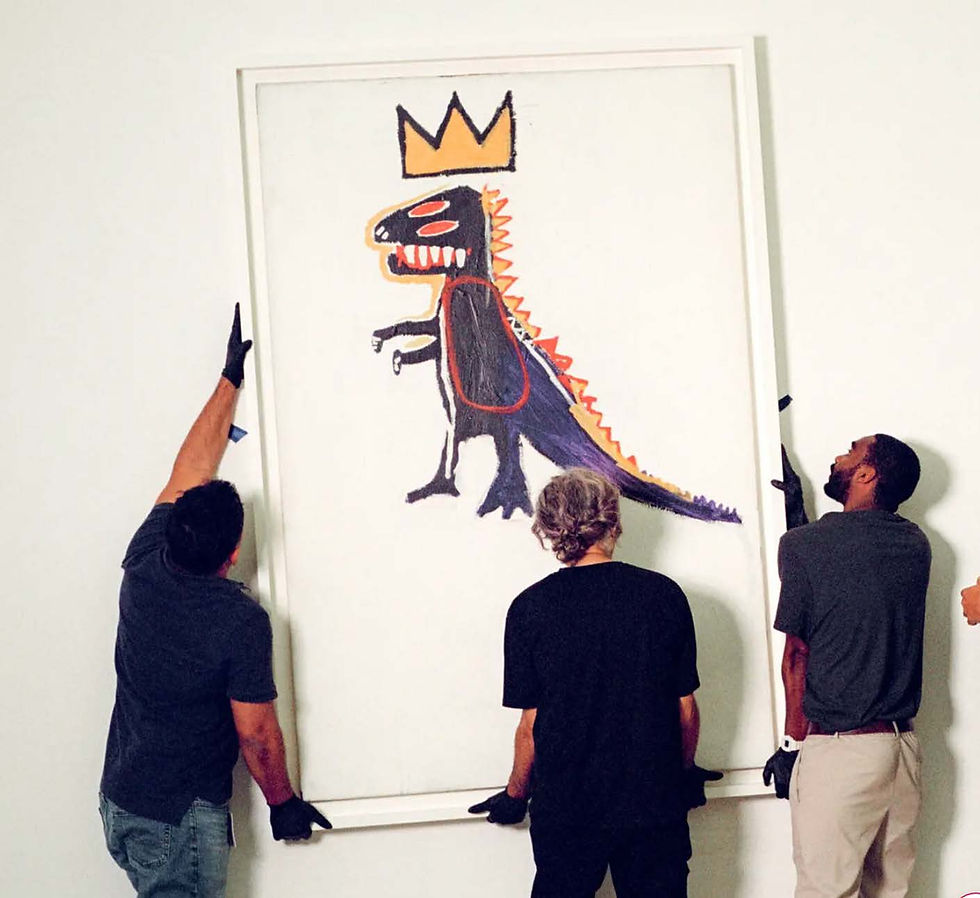
"Everyone is dumping Basquiat,” Ethel Scull said as we sat together at the Pierre Hotel having lunch. I looked at her and thought, how is that possible? He was the hottest young contemporary artist at the time of his death. A few years later, collectors weren’t so sure. Ethel turned out to be right. Collectors worried that museums were not supporting the work, not accepting Basquiat gifts—and MoMA and the Whitney didn’t have a Basquiat in their collections. The Estate, managed by Basquiat’s father, didn’t have a handle on all the unauthorized and undocumented works floating around the art world. Panic selling and an economic downturn left collectors heading for the exits.
I was a student at Columbia and beginning to think seriously about opening an art gallery when a family friend introduced me to Ethel Scull. We had lunch a couple of times and spent some time together. Then an article appeared in the New York Post, on PAGE 6. It claimed that Ethel Scull was going to be my partner in a new gallery. News to me! We laughed about it, but I thought there was probably a good chance she had planted that story.
In 1973, Robert and Ethel Scull’s extraordinary Abstract Expressionist and Pop Art collection was sold at Sotheby’s. The groundbreaking auction reset the art world and ideas about collecting art. When the Sculls had started collecting art in the 1950s, they had very little competition. Ethel Scull had inherited a valuable part interest in her father’s taxicab business. Robert parlayed that into becoming a taxi medallion magnate, living on Fifth Avenue across from the Met. Robert was building a reputation through marketing his Scull’s Angels taxi business and had become a public figure in New York City. The couple saw collecting art as a lifestyle upgrade. In the early days, Robert was deciding on the art they bought, often without much prior consideration, based on instinct. He succeeded by networking with artists whose work he bought and their dealers, such as Leo Castelli, and since there were so few other collectors at the time, he had his choice of works from early shows of Jasper Johns.
The Sculls didn’t need to sell in 1973, but Robert wanted to solidify his place as a tastemaker and art world market maker. He observed how hot Pop Art had become, and he thought it looked like a good business decision to sell, proving his theory that art is a commodity. The same talent he had for promoting his business with PR and marketing he used to promote the auction. He ensured three video crews followed him around in the days before the auction and while it took place. It was the first time these aggressive marketing tools were employed to sell contemporary art—a multi-pronged blitz that major auction houses copy to this day.
The auction results divided the art world, especially the artists who had sold work from their studios for hundreds of dollars and then saw their work sell for thousands at this auction. Bad feelings ensued; Robert Rauschenberg got into a shoving match with Robert Scull at the sale over artist resale rights. Rauschenberg felt artists were being ripped off, but Scull countered that the sale lifted their prices and, in his opinion, artists would make more money in the end. For all the controversy, this moment is considered today a watershed event that permanently turned the contemporary and modern art world into a global investment market. The ultimate casualty of the spectacle was the partnership itself; their marriage ended a year later, kicking off a bitter, decade-long courtroom brawl over who actually owned the art.
When Ethel told me everyone was dumping their Basquiat paintings, she was also selling his work. In May 1990, she sold his work on paper Asbestos at Sotheby’s New York for $37,500. Basquiat’s market suffered following the art-market collapse of 1990, but began recovering later in the decade and accelerated dramatically during the 2000s, as contemporary art attracted a new generation of wealthy collectors—including major figures from the financial industry. In May 2026, Asbestos sold at Christie’s for $6.541 million: a nominal increase of 17,343 percent from the Scull sale. Most people think that the Basquiat market has only gone up, but this story shows how even the savviest collectors can get caught up in the frenzy to sell off an artist they once totally believed in. To be fair, Ethel Scull was at the end of a long battle to get her fair share of the collection following her divorce from Robert Scull. She needed to liquidate for reasons other than the market, and those can be compelling reasons to sell. The outcome of the Scull sale had different consequences; it put collectors on notice that contemporary art could generate serious financial returns.
Unless you were Dorothy and Herb Vogel. Herb and Dorothy would do the rounds of the galleries on Saturdays. I was introduced to them when I first opened my gallery. I was intrigued by how these sweet and unassuming people were so revered by the art world.
They were like many New Yorkers who had this ritual: they would meet friends, do their rounds either at galleries uptown or downtown, later meeting for brunch with friends to discuss what they had seen. This was before the art fairs, so people got their information from art galleries, museum shows and visits to artists’ studios. This was the pre-global art world of the 2000s. Viewing art regularly was part of refining your own personal connoisseurship, or your eye for what you liked.
The Vogels were not wealthy, but they amassed an important collection of Minimal and Conceptual art by artists like Richard Tuttle, Robert Mangold, Donald Judd and John Chamberlain. They spent their non-working hours visiting artists and galleries. Herb Vogel was a U.S. Postal Service employee, and Dorothy was a librarian. They lived in a 450-square-foot apartment in NYC, using Dorothy’s salary to live on while Herb’s was saved to buy art. Their apartment had art hanging on every wall, piled up on every surface, with art crates taking up most of the floor space—and they loved it that way.
The Vogels built their collection through sacrifice, a pursuit of knowledge and their relationships with artists. At the time, they were looking at young and emerging artists who were under the radar. The works were inexpensive, but often the Vogels still had to pay over time. They could only buy works that were small and that they could carry home on the subway, but they were able to amass a collection of over 4,000 works. The Vogels’ embrace of the new and the avant-garde was not as performative as the Sculls’; it was a lifelong conversation about the ideas around art, the artists and the works they collected. They lived, slept and breathed art and never considered that they would ever sell their collection.
Even when they couldn’t actually see the artworks they bought because space was so limited, only a small group could be hung at a time. Herb said that he didn’t care because he knew the art that was there and could summon up the ideas around the work and enjoy them in his head.
When the Vogels retired, their work turned to how they would donate their massive art collection and give it back to the world. The National Gallery now houses much of their collection, along with a program they developed to loan works to museums in all 50 states. They never thought about the monetary value of the art they owned. Artists made sure they got the best pieces at their shows, perhaps because they understood the Vogels were stewards for their art and that one day it would most likely end up in a museum.
The Sculls viewed art as a major financial asset, while the Vogels saw it as a national treasure. One collected art and sold it as a spectacle, while the other investigated art in the quiet of artists’ studios and strictly rejected ever selling it. Both collections increased enormously in value. The difference was what that value meant to the people who owned them.
Knowing what something is worth is not the same as knowing why it’s good.
IMAGE CREDIT
Jean-Michel Basquiat, Pez Dispenser, 1984. Kenneth C. Griffin Collection. The New York Times. Artwork © Estate of Jean-Michel Basquiat. Licensed by Artestar, New York. A Billionaire’s Bounty of Basquiats Goes on Display.